


Dealing with the deadly toll extreme heat exacts on all of us
September 4, 2025
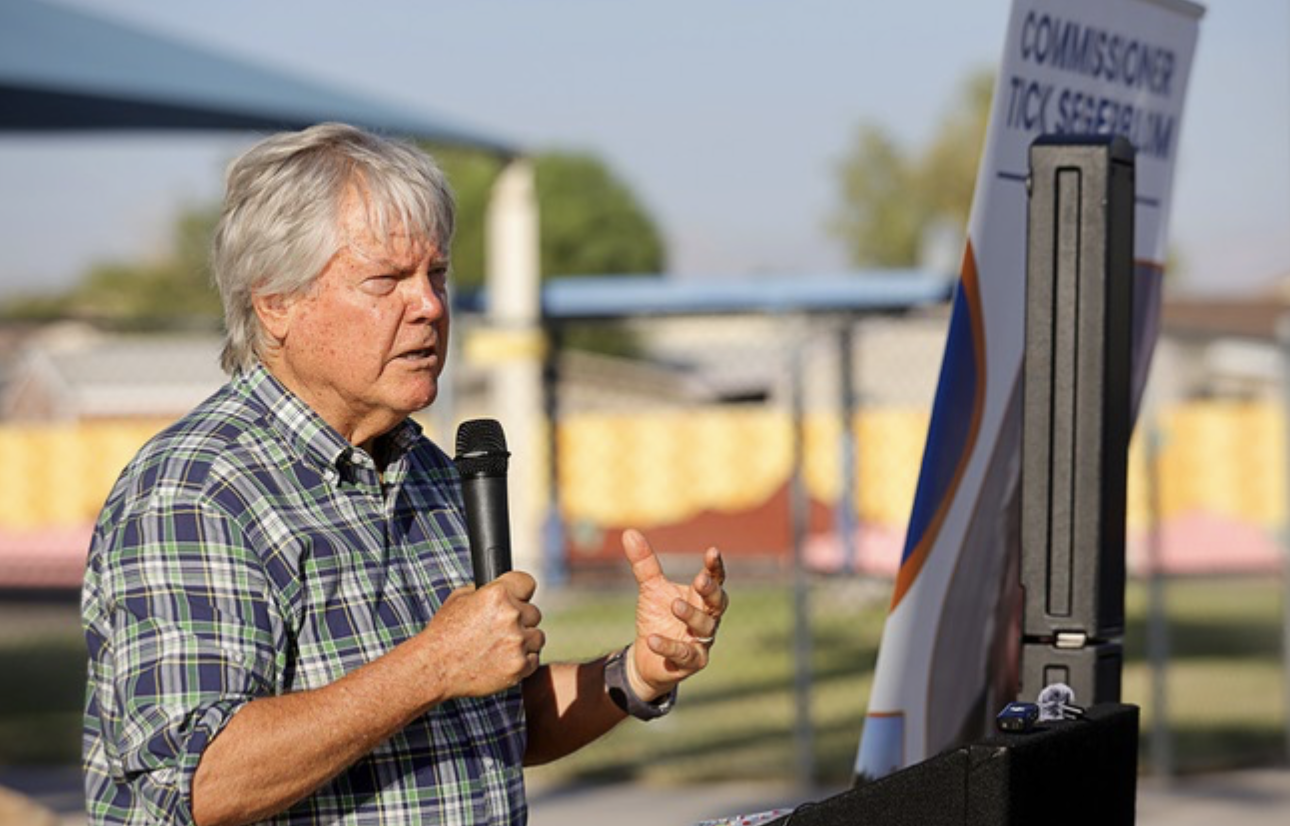

Clark County Commissioner Tick Segerblom speaks during a news conference on safety and immigration at Cortez Elementary School Friday, Aug. 15, 2025. Photo by: Steve Marcus
Saturday, Aug. 30, 2025 | 2 a.m.
In Southern Nevada, heat isn’t just a seasonal inconvenience — it’s a growing public health crisis. Our region is one of the fastest warming in the nation, and every summer, the stakes get higher. The Southern Nevada Water Authority predicts that the number of 100-degree days will keep climbing. Without decisive, coordinated action, these preventable tragedies will not only continue, but will likely get worse.
Extreme heat increases ground-level ozone pollution. It combines with wildfire smoke drifting in from across the West to create hazardous air quality. It drives up utility bills, making housing less affordable. And in some instances, it may even push people into homelessness, making them even less able to protect themselves from the heat.
In addition to serving on the Clark County Commission, I sit on the board of the Regional Transportation Commission of Southern Nevada, chair the Southern Nevada Regional Housing Authority Board and lead the steering committee for Southern Nevada Strong, the region’s growth plan. As I serve on these various committees, I want to sound the alarm: Extreme heat is not just an environmental issue — it is a social equity concern, an economic threat and a public health emergency rolled into one.
How we grow determines how we’ll weather the heat — literally. Our infrastructure, our neighborhoods, even our public services must be designed with rising temperatures in mind.
That’s why mapping the hottest neighborhoods in our region is critical. RTC has been leading that charge. Many know the RTC for its buses, but it’s also our region’s Metropolitan Planning Organization, responsible for long-range transportation and growth planning like Southern Nevada Strong.
In 2022, with the help of more than 60 volunteers and a grant from the National Oceanic and Atmospheric Administration, RTC’s planning team captured 138,000 temperature and humidity readings in a single day. The results were sobering: Areas with little vegetation and lots of asphalt — especially downtown Las Vegas, downtown North Las Vegas, the Historic Westside, and neighborhoods east of U.S. 95 — were significantly hotter. Lower elevation on the east side of the valley, which encompasses a large portion of my district, only amplifies the heat.
Using this data, RTC prioritized installing new transit shelters in the hottest areas of the valley, with another 260 planned over the next year and a half. And each summer, RTC’s annual Summer Heat Campaign offers free water, sunscreen and shade resources to transit riders to help them better navigate the heat.
Data without action is just numbers. Our updated Southern Nevada Strong regional growth plan will account for heat in how we design, build and plan for the future. The good news is, we’re not alone. Desert Research Institute is convening more than 30 partners to improve emergency responses. Nonprofits like Impact NV, The Nature Conservancy and Nevada Plants are planting shade trees. Clark County’s Department of Environment and Sustainability, under the All-In Climate Collaborative, is exploring the creation of a dedicated regional heat office.
These efforts matter. But they also point to one truth: The scale of this challenge demands that we all work together.
In 2026, thanks to a federal grant, Southern Nevada will host an Extreme Heat Summit. This will bring together community leaders, public health officials, emergency responders, transportation planners and advocates to develop a unified regional heat response plan. Done right, it can be a turning point for how Southern Nevada lives with — and survives — our increasingly dangerous summers.
The desert heat is not a background condition — it’s an active, growing threat. If we treat it like an inevitability, it will keep claiming lives. But if we plan, invest and innovate together, we can protect our residents, strengthen our infrastructure and build a region that thrives even under the sun’s harshest glare.
Our summers are only getting hotter. The question is whether we’ll get smarter, faster.
We can do this! Si se puede!

Nevada Plants
Leave a Reply